The early days of basketball before dribbling, dunking, and fast breaks.
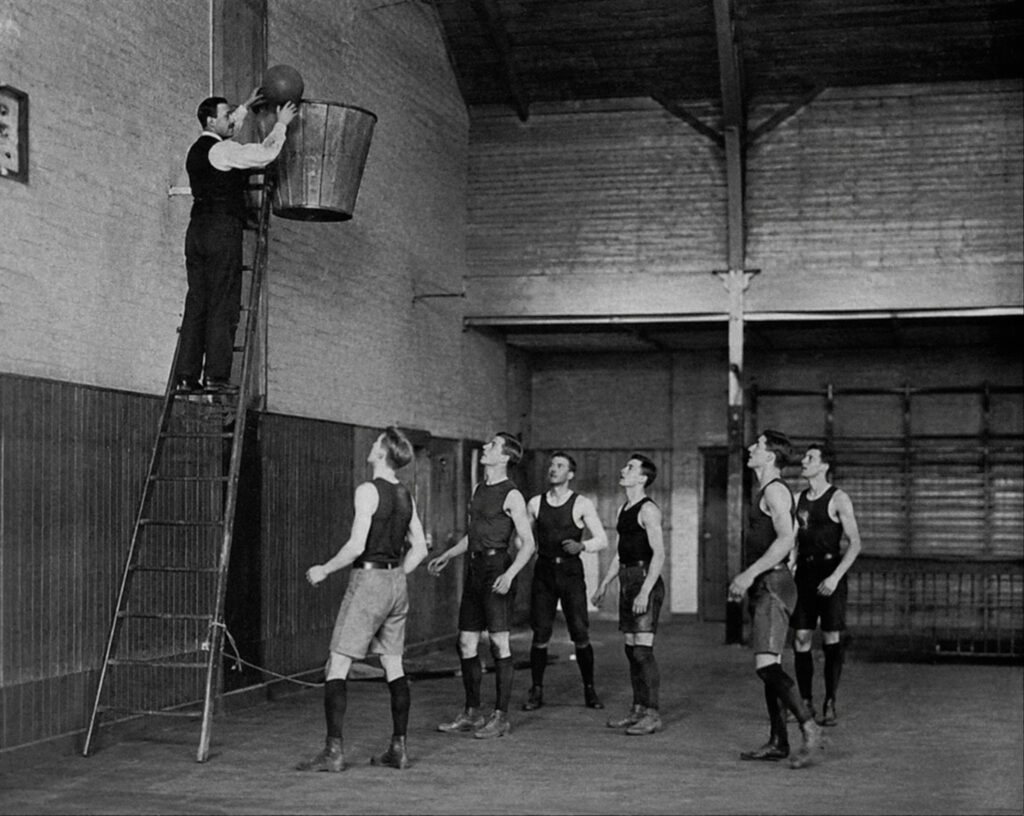
Imagine sitting courtside at a basketball game where every made basket completely stops the action. No fast breaks. No inbound passes. No transition offense. No highlight dunks. Just players standing around while somebody drags over a ladder to retrieve the ball by hand. As ridiculous as that may sound now, that is basically what the very first basketball games looked like.
A Humble Start
Basketball was invented in December of 1891 by James Naismith, a Canadian physical education instructor working at the International YMCA Training School in Springfield, Massachusetts. Winters in Massachusetts were brutal, and students were becoming restless being stuck indoors. Football was considered too rough to play inside a gymnasium, and most indoor exercises at the time were repetitive and boring.
Naismith was given a challenge: Create a game that could be played indoors during winter, keep athletes active, and avoid the violent injuries common in football and rugby.
He had just a couple of weeks to come up with something. After thinking through different ideas, he decided the game needed a few important things:
- A ball that could be passed rather than carried
- A goal that rewarded accuracy instead of brute force
- Less physical contact than football
- Enough movement to keep players active indoors
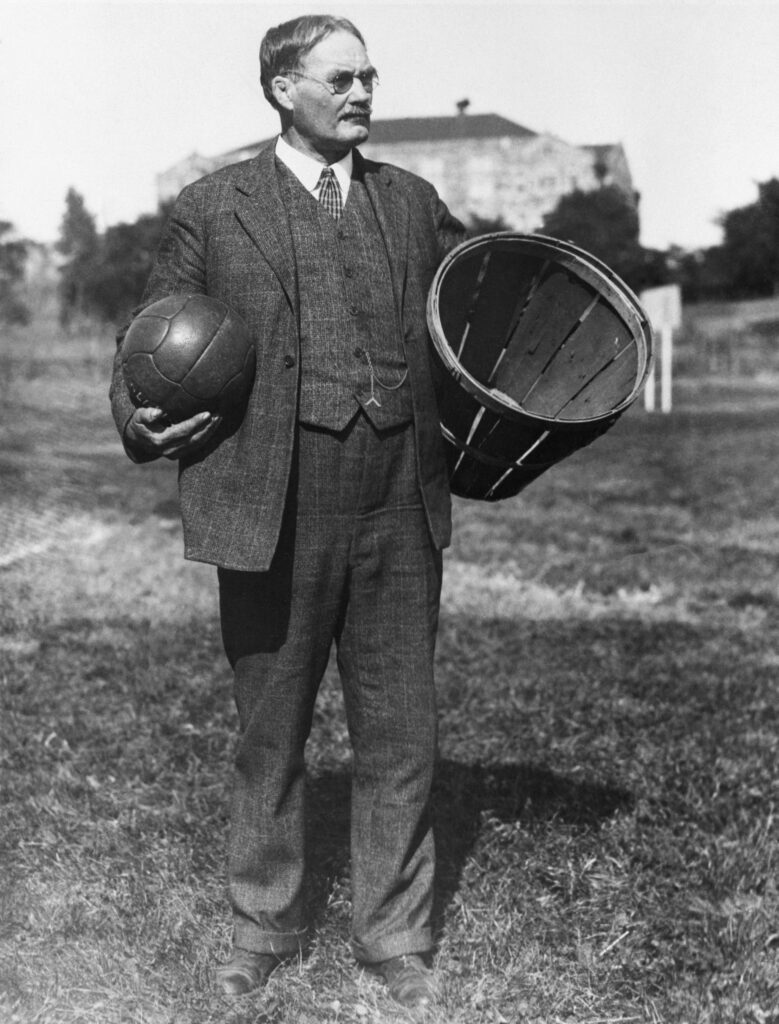
So he grabbed a soccer ball, asked the school janitor for two boxes to use as goals, and instead received two peach baskets.
Those peach baskets were nailed to the lower railing of the gym balcony exactly 10 feet off the ground, a height that would accidentally become one of the most famous measurements in sports history. And yes… the baskets still had their bottoms attached.
That meant every single time someone scored, the game had to stop completely while someone climbed a ladder to retrieve the ball. Think about how strange that would feel in today’s game. Imagine a packed arena erupting after a huge shot, only for the entire game to pause while somebody climbs a ladder to get the ball back. That was basketball.
Eventually, they upgraded from ladders to using a long wooden pole to push the ball out from underneath the basket, which at the time probably felt like revolutionary technology. But the early version of basketball was even stranger than most people realize. There was originally no dribbling. None.
Players were not allowed to run with the ball, and bouncing it while moving was not yet part of the game. The only way to move the ball down the court was by passing it to teammates. Because of that, the game looked completely different from modern basketball. It was slower, more crowded, and relied heavily on teamwork and positioning.
In many ways, it looked more like a mix of soccer, football, and keep away than the modern version of basketball we know today. The original rules were handwritten by Naismith himself and consisted of just 13 basic rules typed onto two sheets of paper and hung in the gymnasium.
Some of those original rules sound completely foreign now. For example:
- Players could not run with the ball
- There was no three point line
- No shot clock
- No dribbling
- No dunking
- No backboards
- Jump balls happened constantly
- Physical contact like shoulder charges and holding opponents was banned from the start
Naismith’s 13 original rules
BASKET BALL.
We present to our readers a new game of ball, which seems to have those elements in it which ought to make it popular among the Associations. It fills the same place in the gymnasium that foot ball does in the athletic field. Any number of men may play it, and each one get plenty of exercise; at the same time it calls for physical judgment, co-ordination of every muscle, and gives all-around development. It can be played by teams from different Associations, and combines skill with courage and agility so that the better team wins.
The ground is the gymnasium floor cleared of apparatus (it may be played behind the side lines), though it could be played in the open air, at a picnic, etc. Where there is a running track around the gymnasium, the ground might be marked out just under the track, and the baskets hung up, one at each end on the railing. All outside of this line is then out of bounds. When there is no running track, the ends may be cleared of apparatus, and the goals fixed on the wall, then a line may be drawn along the sides of the gymnasium about six feet from the walls, or enough to clear the apparatus. Across these lines would be out of bounds.
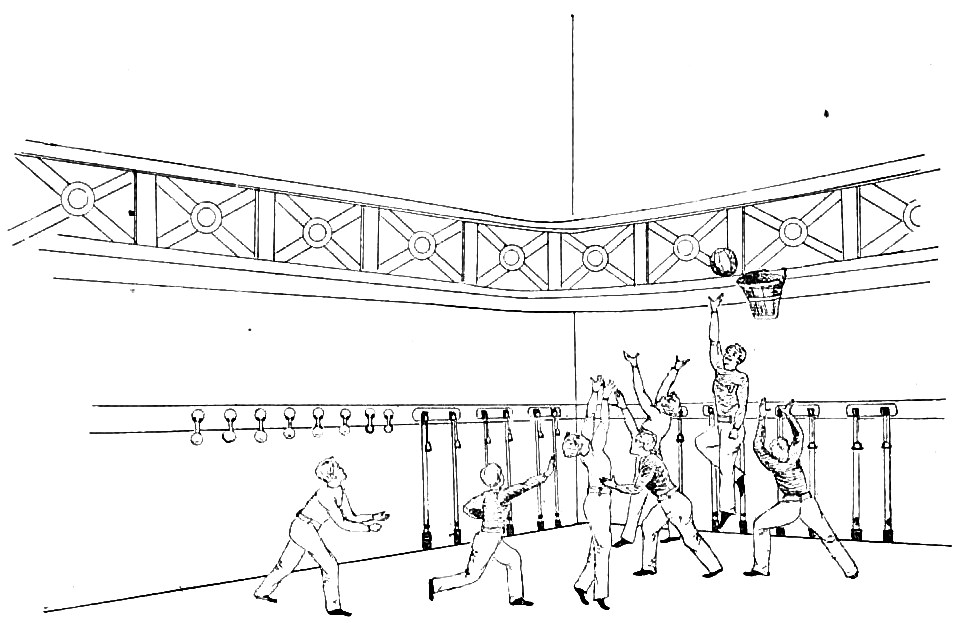
The goals are a couple of baskets or boxes about fifteen inches in diameter across the opening, and about fifteen inches deep. These are to be suspended, one at each end of the grounds, about ten feet from the floor. The object of the game is to put the ball into your opponents’ goal. This may be done by throwing the ball from any part of the grounds with one or both hands, under the following conditions and rules:
- The ball may be thrown in any direction with one or both hands.
- The ball may be batted in any direction with one or both hands, never with the fist.
- A player cannot run with the ball. The player must throw it from the spot on which he catches it, allowance to be made for a man who catches the ball when running at a good speed if he tries to stop.
- The ball must be held in or between the hands; the arms or body must not be used for holding it.
- No shouldering, holding, pushing, tripping, or striking in any way the person of an opponent shall be allowed; the first infringement of this rule by any player shall count as a foul, the second shall disqualify him until the next goal be made, or, if there was evident intent to injure the person, for the whole of the game, no substitute allowed.
- A foul is striking at the ball with the fist, violation of rules 3, 4, and such as described in rule 5.
- If either side makes three consecutive fouls, it shall count a goal for the opponents (consecutive means without the opponents in the meantime making a foul).
- A goal is made when the ball is thrown or batted from the grounds into the basket and remains there, providing those defending the goal do not touch or disturb the goal. If the ball rests on the edges, and the opponent moves the basket, it shall count as a goal.
- When the ball goes out of bounds, it shall be thrown into the field of play by the person first touching it. In case of dispute, the umpire shall throw it straight into the field. The thrower in is allowed five seconds, if he holds it longer, it shall go to the opponent. If any side persists in delaying the game, the umpire shall call a foul on that side.
- The umpire shall be judge of the men and shall note the fouls and notify the referee when three consecutive fouls have been made. He shall have power to disqualify men according to Rule 5.
- The referee shall be judge of the ball and shall decide when the ball is in play, in bounds, to which side it belongs, and shall keep the time. He shall decide when a goal has been made, and keep account of the goals with any other duties that are usually performed by a referee.
- The time shall be two fifteen minutes’ halves, with five minutes’ rest between.
- The side making the most goals in that time shall be declared the winner. In case of a draw, the game may, by agreement of the captains, be continued until another goal is made.
This game is interesting to spectators as well as to the players, and may be made quite scientific by good judgment combined with good co-ordination. Several good points have been scored by two or three players working together. The number composing a team depends largely on the size of the floor space, but it may range from three on a side to forty. The fewer players down to three, the more scientific it may be made, but the more players the more fun, and the more exercise for quick judgment.
The men may be arranged according to the idea of the captain, but it has been found advantageous to have a goal keeper, two guards, three center men, two wings, and a home man stationed in the above order from the goal.
It shall be the duty of the goal keeper and the two guards to prevent the opponents from scoring. The duty of the wing man and the home man is to put the ball into the opponents’ goal, and the center men shall feed the ball forward to the man who has the best opportunity, thus nine men make the best number for a team.
It is well suited for boys. Director Finch has introduced it in his boys’ classes with apparent success. We wish that the physical directors would try the game, and report any points that might be amended.
It is intended that this game should be free from much of the reputed roughness of Rugby, and in the framing of the rules this has been kept strictly in view. If some of the rules seem unnecessarily severe, it will be remembered that the time to stop roughness is before it begins.
A gymnasium is bounded by hard walls, and has a pretty solid floor, and for that reason, any showing that would injure a person must be stopped, e.g., when a man raises his arms to throw the ball, another might give him the shoulder, and disable him, but if this is stopped there will be an understanding that it is not allowed. It is for the benefit of a physical director that no man be hurt in his gymnasium, so that any director who tries it should make every man conform to the rules strictly at first, and then he would soon get accustomed to playing ball instead of trying to injure his neighbor, when it is nothing but a friendly tussle in which they are taking part.
The very men who are rough in playing will be the very first ones to oppose the game on this account, for there is that in man’s nature which will retaliate, and the rough player generally gets the worst of the roughness. If there is need for such a game, let it be played as any other game of science and skill, then men will value it. But there is neither science nor skill in taking a man unawares, and shoving him, or catching his arm and pulling him away, when he is about to catch the ball. A dog could do as much as that.
There seemed to be no way of compensating the opponents for a foul made. A free throw was thought of, but after a little practice, a good thrower could convert it into a goal almost every time, because of the limits of the ordinary gymnasium. Then the idea was that three fouls would count as a goal, and would be a deterrent to the making of them. This is true, for when a team finds that another foul would count a goal against them, the extra foul is hardly ever made, showing that it is possible to play the game without making fouls.
If men will not be gentlemanly in their play, it is our place to encourage games since they be played by gentlemen in a manly way, and show them that science is superior to brute force with a disregard for the feelings of others. The umpire will thus be responsible for much of the roughness if he lets it go unchecked, but if he is firm and impartial in his ruling he will gain the respect even of those who suffer at the time.
We would advise the director to keep a good firm grasp on the ruling for a while at first.
JAS. NAISMITH.
One of the most interesting parts of the original game was Naismith’s focus on reducing violence. At the time, football injuries were becoming a major concern, and he specifically designed basketball to reward skill and strategy over brute force. That is one reason the goal was placed above the players instead of on the ground.
Naismith believed elevating the basket would reduce direct collisions because defenders could not simply stand in front of a net like they could in soccer or hockey. Players had to shoot upward with touch and accuracy instead of charging straight ahead through defenders. Ironically, the game eventually evolved into one of the fastest and most explosive sports in the world anyway.
The Very First Basketball Game
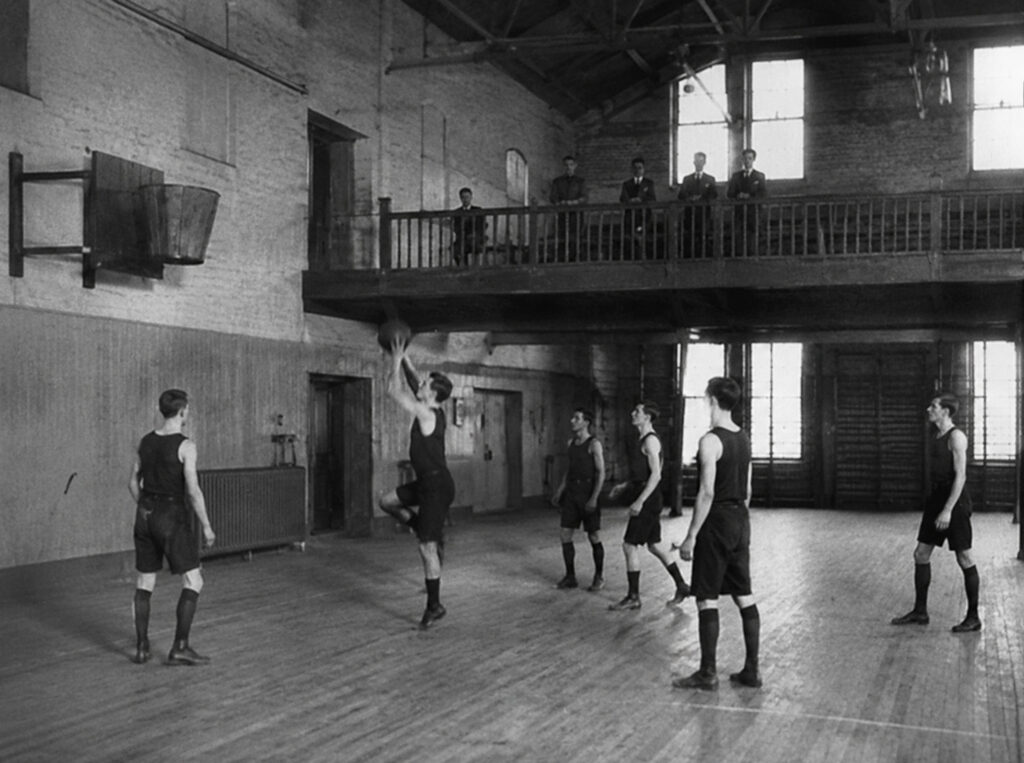
The first official basketball game was played on December 21, 1891.
There were only 18 players total, 9 on each side, and the final score was… 1 to 0.
That single basket came from a shot made about 25 feet away, which at the time was considered incredibly impressive. Compare that to today, where teams regularly score well over 100 points and players casually pull up from distances that would have seemed impossible in 1891.
Another thing many people do not realize is that the famous 10 foot hoop height was never carefully engineered after years of testing. It was basically accidental.
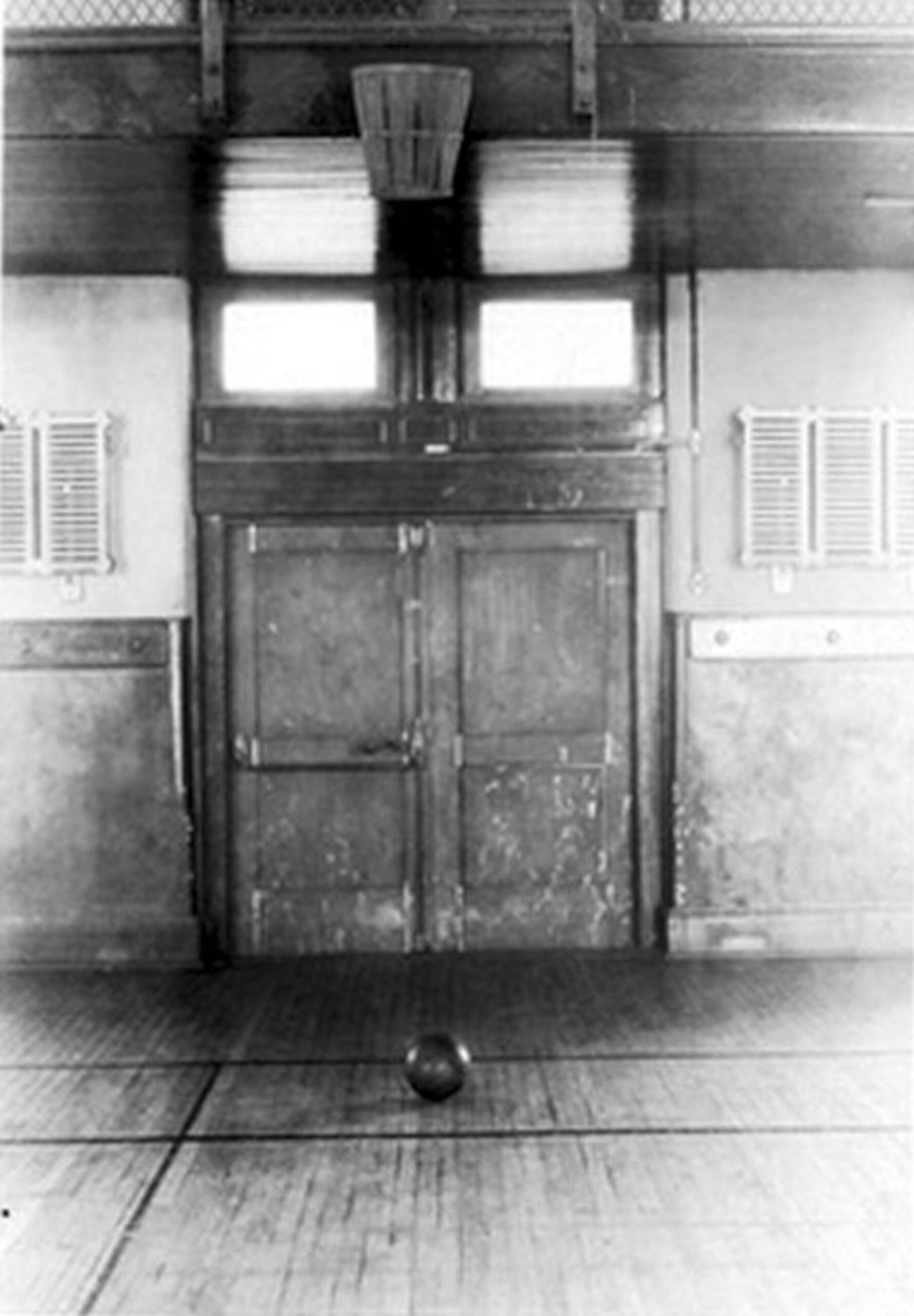
The running track railing inside the gym happened to be 10 feet high, so that is where the peach baskets were attached. As basketball spread rapidly across schools, YMCAs, colleges, and eventually professional leagues, the height simply stuck. More than 130 years later, that same measurement is still used almost everywhere basketball is played.
Think about how rare that is in sports
The equipment changed.
The uniforms changed.
The courts changed.
The rules changed.
The athletes became bigger, faster, and more skilled than Naismith could have ever imagined. But the hoop height stayed exactly the same.
Basketball spread incredibly fast after its invention. Within just a few years, the game was being played across YMCAs throughout the United States. Soon after, it spread internationally through schools and YMCA programs around the world. By the early 1900s, basketball was already growing in popularity across Europe, Asia, and South America.
Today, basketball is played everywhere from packed professional arenas to cracked driveways and neighborhood parks. Kids imitate NBA stars on backyard hoops. Entire towns rally around high school teams. Millions of fans follow the NBA, college basketball, Olympic basketball, and international leagues every year.
It all traces back to a winter gymnasium, a soccer ball, two peach baskets, and a game that once paused after every single basket just to get the ball back.
Leave a Reply